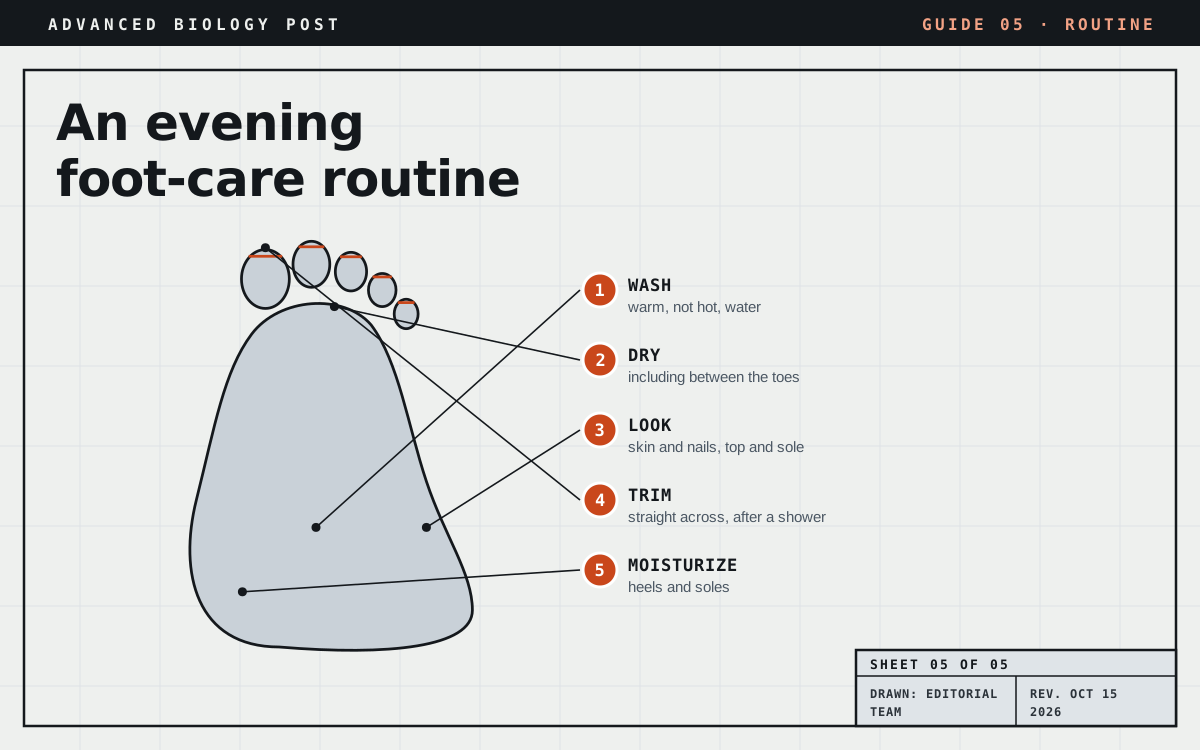
A sensible evening foot routine is short: wash your feet in warm, not hot, water, dry them well including between the toes, look over the skin and nails top and bottom, trim toenails straight across when they need it, and moisturize the heels and soles. That is the common ground of NIH, dermatology and podiatry guidance; none of it needs special equipment beyond a towel, a straight-edged toenail clipper, a file and a plain moisturizer.
Why the evening
Most foot-care advice is written as “every day,” without a time. The evening is a practical choice for two reasons in the sources. NIH’s foot-care checklist suggests checking your feet each evening when you take off your shoes, because that is a moment you will remember [1]. And the AAD says the best time to trim nails is right after a bath or shower, when they are softer [2]; for many people that shower is in the evening. Shoes come off, socks go in the wash, and the feet are already bare.
MedlinePlus, the NIH consumer site, sums up the basics in four lines: examine your feet regularly, wear comfortable shoes that fit, wash your feet daily with soap and lukewarm water, and trim toenails straight across and not too short [3]. The routine below simply puts those into an order.
The routine is about noticing, not fixing. Its most useful step is the third one, looking, because it is how you catch a change early enough to ask someone qualified about it.
The five steps
The order matters a little: washing softens nails for trimming, and moisturizer goes on last so it does not make the clipper slip.
Wash warm, not hot, water
Use soap and warm water. NIH’s checklist says warm, not hot, and suggests testing it with a thermometer (90–95 °F is given as safe) or your elbow [1]. The same checklist advises against long soaks because they dry the skin [1]. A short wash is enough.
Dry including between the toes
Dry thoroughly, especially between the toes, where skin tends to stay damp [1] [4]. APMA puts it as a rule: don’t leave any moisture between the toes [5]. Pat with the towel and give each gap a pass.
Look skin and nails, top and sole
Check the tops, the soles, the heels and between the toes. NIH suggests a mirror, or another person, if bending to see the soles is hard [1]. MedlinePlus Magazine lists what to look for: cuts, sores, blisters, cracks, changes in skin color, and changes in the nails such as discoloration [4].
Trim straight across, after a shower
Only when the nails need it; toenails grow more slowly than fingernails [2]. Use a toenail clipper with a straight edge and cut straight across; APMA says small, curved fingernail clippers and manicure scissors are the wrong shape for toenails, and not to round the edges [5]. File rough edges with an emery board in one direction only [2].
Moisturize heels and soles
Rub a thin coat of lotion or cream on the tops and bottoms of the feet, paying attention to dry or rough areas such as the heels, but not between the toes [1] [4]. APMA describes the aim as keeping the soles soft [5]. Then put on clean, dry socks if you wear them to bed [4].
Tools, and keeping them clean
The routine needs four things: a towel, a toenail clipper with a straight jaw, an emery board or file, and a plain moisturizer. A few rules from the sources apply to the tools themselves:
- Keep a separate toenail clipper. The AAD advises a toenail clipper for toenails and a nail clipper or scissors for fingernails [2].
- Clean the clipper monthly: scrub it with a small brush soaked in 70–90% isopropyl alcohol, rinse in hot water, and dry it completely [2].
- Don’t share emery boards. APMA notes they are porous and cannot be sterilized [5].
- Leave the cuticles uncut. The AAD and APMA agree on not cutting them; they differ on pushing them back (the AAD says leave them alone, APMA allows gently pushing them back with a rubber pusher or manicure stick) [2] [5].
- Don’t use sharp tools to clean under the nails [5].
Socks and shoes
The evening is also when shoes come off for the night, which makes it a natural point to deal with them. The AOFAS recommends changing socks every day and letting shoes dry out between wearings [6]; the AAD suggests alternating which pair you wear each day [7]. If you use removable insoles, pulling them out at night lets both the insole and the shoe dry. MedlinePlus Magazine also notes that feet can change over time, and suggests having them measured when you buy shoes [4].
When to ask a clinician
A home routine is for ordinary upkeep. All the sources draw a line where it should hand over to a professional, and the “look” step is how you find that line. Make an appointment with a clinician or podiatrist if you notice:
- Changes in the color, texture or shape of a nail. The AAD says to see a board-certified dermatologist for these [2].
- Thick or yellowed toenails, or nails that curve into the skin. NIH guidance is to have a foot doctor trim them rather than doing it yourself [1].
- Reduced feeling in your feet, or difficulty seeing, feeling or reaching them. NIH guidance is the same: have a foot doctor do the trimming [1].
- Nails that change, swell or hurt [7], or cuts, sores, swelling, redness, or skin changes that do not settle [4].
MedlinePlus Magazine adds that talking to a doctor matters even more for people with a long-term condition that affects the feet [4], and APMA suggests such people ask a podiatrist for a pedicure routine suited to them [5].
This guide describes ordinary hygiene steps from public sources. It is not a substitute for a foot check by a clinician, and no tool, cream or device in our catalog is a remedy for a foot or nail condition. If you have reduced feeling in your feet, an existing condition that affects your feet, or a nail or skin change that worries you, ask a clinician or podiatrist before trimming or working on it at home. Use warm, not hot, water, and test it with your hand or elbow if your feet are less sensitive than they used to be.
Sources
- National Institute of Diabetes and Digestive and Kidney Diseases (NIH). “Diabetes & Foot Problems” page, foot-care checklist: daily checks, washing, moisturizing, trimming and when a foot doctor should trim. The page addresses one patient group; the hygiene steps we use from it are general. Last reviewed January 2017; accessed Oct 15, 2026. link
- American Academy of Dermatology. How to trim your nails. Accessed Oct 15, 2026. link
- MedlinePlus (National Library of Medicine). Foot health. Accessed Oct 15, 2026. link
- MedlinePlus Magazine (NIH). Steps for everyday foot care, June 6, 2024. Accessed Oct 15, 2026. link
- American Podiatric Medical Association. Pedicure pointers: the dos and don’ts. Accessed Oct 15, 2026. link
- American Orthopaedic Foot & Ankle Society, FootCareMD. Taking care of your feet. Accessed Oct 15, 2026. link
- American Academy of Dermatology. Dermatologists’ tips for healthy nails. Accessed Oct 15, 2026. link
This guide is educational and is not medical advice. Ask a qualified clinician before starting a new device or routine, especially if you have an existing condition, reduced feeling in your feet, an implanted device, or take medication.