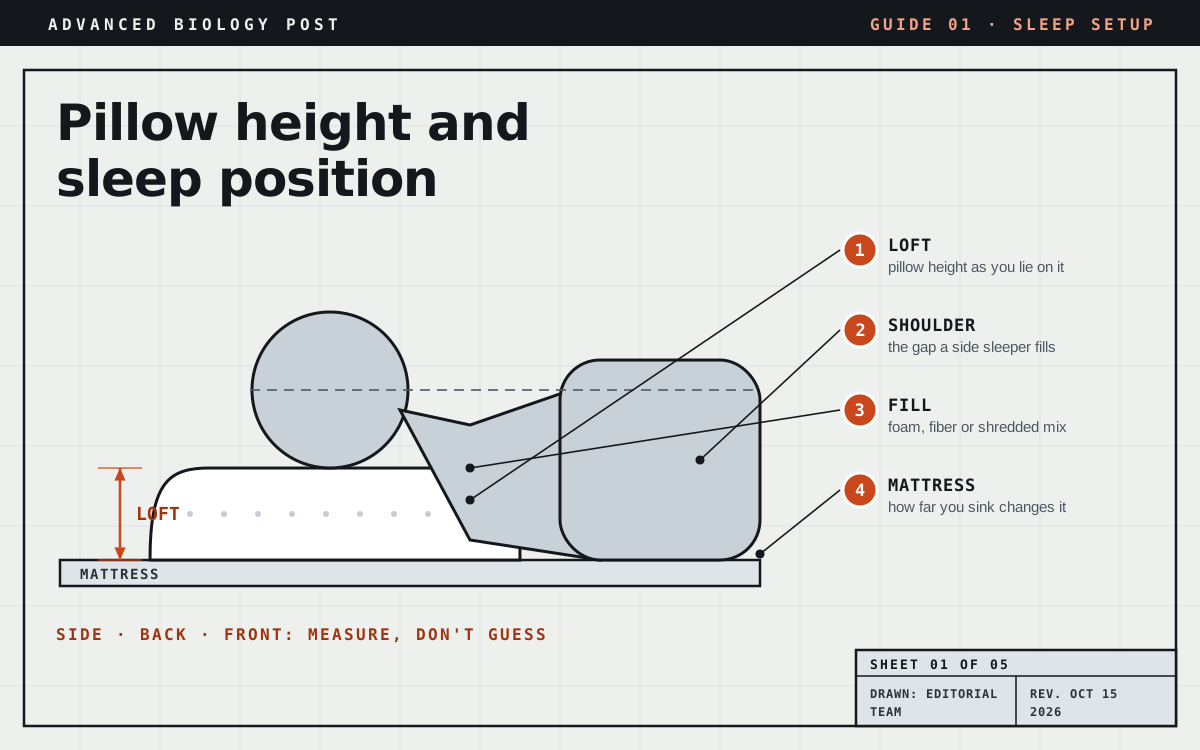
The right pillow height is the one that keeps your head roughly in line with the rest of your spine in the position you actually sleep in, and that height is different for different bodies. Studies measure it with spine angles, pressure maps and muscle activity, but a 2021 review of that work concluded the evidence is not yet strong enough to name one ideal height for back or side sleeping [1], so the useful skill is checking your own setup.
What “loft” means
Loft is pillow height. The number on a box is usually measured with nothing on the pillow, but what matters is the height as you lie on it, after your head has pressed it down. A fluffy fiber pillow and a dense foam pillow with the same listed loft can end up at very different heights under a head.
Researchers judge pillow height in four main ways: how straight the neck sits relative to the upper back, body dimensions such as shoulder width, contact pressure under the head and neck, and electrical activity in the neck and shoulder muscles [1]. None of these gives a single height for everyone, which is why manufacturers sell several sizes or adjustable fill.
Judge a pillow by its compressed height under your own head, not the uncompressed number on the label.
Side, back and front sleepers
Advice differs by position because the gap the pillow must fill differs.
- Side. The pillow has to span the distance from the mattress up to the head, which is set mostly by the width of the shoulder. That is the largest gap, so side sleepers usually need the highest loft. The 2025 lab study found that the height giving the most natural neck curve on the side depended on each person’s shoulder width [3].
- Back. The head rests behind the body, so the gap is smaller. Studies of back sleeping do not agree on a single figure: the 2021 review cites one study favoring about 10 cm and another about 7 cm [1].
- Front. Research is thinnest here. The 2021 review notes that front sleeping and in-between postures were barely studied [1]. Some pillow makers ship fill you can remove (Coop’s listing names front sleepers [5]), while Tempur says its contour pillow is designed for side and back sleepers only [4].
Most people also move. A study cited in the 2021 review recorded about 24 posture changes a night, mostly between back and side, and found participants’ own pillows were too high for back sleeping and too low for side sleeping [1]. Some experimental designs answer this with a lower middle for back sleeping and higher sides for side sleeping [1]; on any pillow, it is worth checking the height in both of your usual positions.
Shoulder width and mattress softness
These two labels on the cover work against each other. A broad shoulder raises the gap a side sleeper needs to fill. A soft mattress lets that shoulder sink, which lowers the gap again. The same person can need a different loft on a firm mattress than on a plush one. That part is plain geometry rather than a study finding, but it explains why the same pillow can feel right in one bed and wrong in another.
Shoulder width is the measurement the 2025 study used to predict each person’s height: its index combined shoulder width with pillow height, and it predicted the neck curve well (R² about 0.8). The same study found that people’s comfort ratings tracked that index only moderately or weakly [3]. In other words, what feels comfortable on the first night and what lines the neck up are not always the same thing, which is a reason to check alignment rather than rely on feel alone. It tested nine healthy adults, so read it as a pointer, not a rule.
Fill: fixed shapes versus adjustable pillows
Fill decides how much a pillow compresses and whether you can change it.
- Molded foam (for example the TEMPUR-Ergo Neck Pillow): one fixed shape and height per size; you choose the height once, at purchase [4].
- Loose shredded or cross-cut foam with fiber (for example the Coop Original Adjustable Pillow): the height is set by how much fill you leave inside, and it can be changed any night [5].
- Fiber or feather: soft fills that compress under the head and shift during the night; how far they compress varies, so the listed loft is only a starting point.
The 2021 review of pillow designs found that what a pillow is made of seemed to matter less for side-lying neck alignment than its shape and height [2]. That review mostly covered adults with existing neck complaints and found no measurable effect of pillow design on sleep quality in that group, so it is not evidence that any pillow improves sleep.
How to check your own setup
This is a simple sequence; it needs a ruler, a mirror or a second person, and a few nights.
Note your real positions before buying
Which positions do you fall asleep in and wake up in? If you switch, the pillow has to work for both.
Measure the shoulder 2 minutes
Tempur’s method: hold a ruler perpendicular to your neck and measure from the base of the neck to the outer edge of the shoulder; if you fall between two sizes, choose the smaller [4].
Look from the side and from the foot of the bed on your own mattress
Lie in your usual position and have someone look, or take a photo. On your side, see whether your head tilts up toward the ceiling or drops toward the mattress compared with the line of your upper back; on your back, see whether your chin is pushed toward your chest or tipped back. Neck alignment is the main measure the research uses [1].
Adjust in small steps over several nights
If your head tips up, go lower; if it drops, go higher. With an adjustable pillow, move a handful of fill at a time; with a fixed one, the next size down or up is the only lever.
This guide is about comfort and setup, not about any health condition. If you have ongoing neck, shoulder or back symptoms, changes in feeling in your arms or hands, or a breathing problem during sleep, ask a clinician which sleeping position and pillow height suit you, and follow that advice over anything here.
Sources
- Review of the measures used to evaluate pillow height (spine alignment, body dimensions, contact pressure, muscle activity), 1997–2021 studies. Healthcare (Basel), 2021;9(10):1333. PMID 34683013. PubMed
- Systematic review and meta-analysis of pillow designs in adults, including spinal alignment and sleep quality outcomes. Clinical Biomechanics, 2021;85:105353. PMID 33895703. PubMed
- Laboratory study of individualized pillow height and neck support for side sleepers (9 healthy adults, four heights). Medical & Biological Engineering & Computing, 2025;63(2):535-544. PMID 39412632. PubMed
- Tempur-Pedic. TEMPUR-Neck Pillow product page: profile sizes and sizing method (manufacturer information). Accessed Oct 15, 2026. link
- Coop Sleep Goods. The Original Adjustable Pillow product page: add-or-remove fill, sleep positions named (manufacturer information). Accessed Oct 15, 2026. link
This guide is educational and is not medical advice. Ask a qualified clinician before changing your sleep setup if you have an existing neck, shoulder, back or breathing condition.