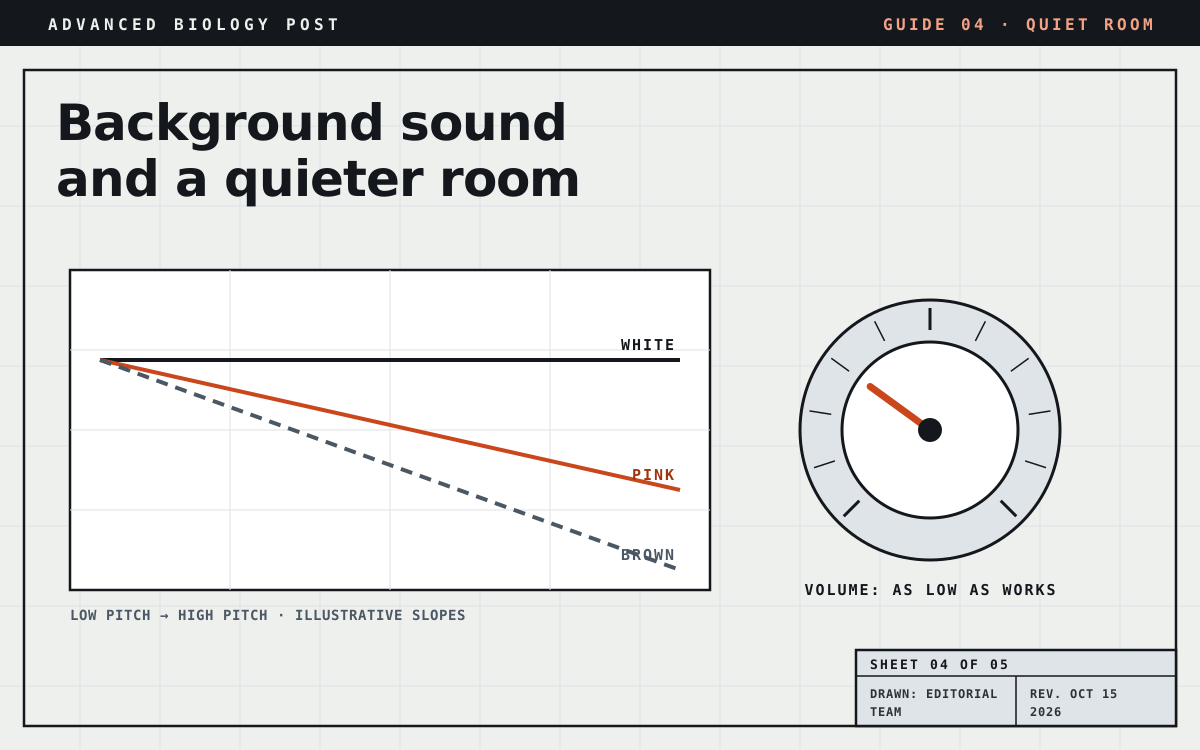
Steady background sound works by masking: it raises the floor of sound in a room so that a door, a car or a voice is a smaller jump above it. Whether that changes how people sleep is far less clear; the largest systematic review rated the evidence that continuous noise improves sleep as very low quality [1], and a careful 2026 lab study found a downside as well as an upside [2].
White, pink, brown and fan sound
The “colors” describe how a steady hiss spreads its energy across pitch. The slopes on this guide’s cover are illustrative, not measurements.
- White noise has equal energy at every frequency. Each higher octave spans more frequencies, so white noise carries more energy per octave as pitch rises and sounds bright and hissy.
- Pink noise loses energy as pitch rises, so each octave carries the same energy. It is often compared to steady rain.
- Brown noise (sometimes called red) falls off faster still, leaving mostly low rumble.
- Fan sound is a real broadband sound from moving air; its exact spectrum depends on the fan and its housing, so it is not a laboratory white noise. A fan-based machine such as the SNOOZ Original lets you shift the tone by rotating its shell [6].
Studies use these terms loosely. The 2021 review grouped white noise with “similar broadband noise” and found the sound itself was often poorly described, which is part of why results are hard to compare [1].
How masking works
What disturbs sleep is usually change: a noise that rises suddenly above the background. A steady sound does not make outside noise quieter; it makes the difference smaller. A door closing in a silent room is a large jump, and the same door against a steady hiss is a smaller one.
That is also why masking has a cost. To shrink the jump, the background has to be fairly loud, and you hear it all night. In the 2026 lab study, adding pink noise at 40 or 50 dBA reduced some of the brief awakenings caused by noise events in a dose-dependent way, but it also shortened REM sleep on its own, and the combination left sleep structure worse overall; foam earplugs blunted nearly all the effects of the noise events and only began to fail at the loudest level tested [2][3].
Masking narrows the gap between a background and a noise; it does not remove the noise. Earplugs and a quieter room do the opposite: they lower the noise itself.
What the research found
The evidence is thin and mixed. Here is what the main reviews and trials say, in order of scope.
- 2021 systematic review, 38 articles. Results ranged from better sleep to worse sleep. Studies differed in the sound used, how sleep was measured and how well people stuck with it. Using the GRADE system, the reviewers rated the quality of evidence for improved sleep as very low and said more research is needed before promoting continuous noise as a sleep aid, noting it may also affect sleep and hearing negatively [1].
- 2025 meta-analysis, 12 randomized trials, 1,301 participants. In adults, many of them hospital patients, white noise was linked to better scores on a sleep-quality questionnaire; in infants, results were mixed across measures. The authors flagged large differences between studies and variable quality [7].
- 2026 lab study, 25 adults. Pink noise reduced REM sleep; earplugs did more than pink noise to blunt intermittent traffic, rail and aircraft sounds [2][3].
- 2024 scoping review on children. Some machines can exceed 91 dB at maximum volume; the authors supported limits on volume and duration for devices used around young children [8].
Put plainly: a steady sound may make sudden noises less noticeable for some people, and some people simply prefer it to silence. The research does not show that it improves sleep for most people, and it shows that loudness carries a real cost.
Volume: as low as works
The cover’s rule is the one point the sources agree on. NIDCD describes 70 dBA and under as unlikely to damage hearing over any length of time, places the risk line for extended or frequent exposure at 85 dBA and up, and adds that how far you are from the source and how long you listen count as much as the level [4]. A sound machine at night runs for hours, every night, so it is long exposure by design.
Start at the lowest setting first night
Raise it one step at a time only until the noise that bothers you is less noticeable, and stop there.
Move it away from your head at setup
Level falls with distance. The SNOOZ manual suggests placing its unit away from the bed, near a wall, and between the bed and the noise source [6].
Check the level where you sleep once
Some machines’ apps include a decibel check; a phone sound-meter app gives a rough reading. Aim well under NIDCD’s 70 dBA line at the pillow.
Use a timer if you only need help falling asleep nightly
A schedule or timer cuts the hours of exposure.
A quieter room first
For outside noise, lowering it is more direct than covering it. WHO Europe’s guidelines recommend keeping night-time noise below about 45 dB for road traffic, 44 dB for rail and 40 dB for aircraft; those are long-term averages measured outside, at the most exposed wall, and are meant for planners rather than for a bedside meter [5]. They still show that the target for a sleeping room is quiet.
- Close windows on the noisy side, or sleep on the quieter side of the home if you can.
- Soft furnishings (curtains, rugs) absorb some reflected sound inside the room.
- Foam earplugs outperformed pink noise against intermittent noise in the 2026 study [2].
- If you use a sound machine, keep it off the bed, uncovered, and at the lowest level that works.
Some people simply prefer a low, steady sound to a silent room, and that includes some people who hear a sound with no outside source. NIDCD’s health page on that experience says the first step is a visit to a doctor to look for a cause [9]. We mention it only so the context is complete: a fan or sound machine is a room-comfort choice, not a remedy for any ear or hearing symptom, and no device on this site is described or sold as one.
Keep volume low, especially around babies and children; the SNOOZ manual notes that safe hearing thresholds are lower for young children than for adults [6]. If you notice a change in your hearing, a sound in your ears that does not go away, or sleep problems that last, see a clinician or audiologist rather than turning up a machine.
Sources
- Systematic review of continuous white or broadband noise and sleep (38 articles, GRADE assessment). Sleep Medicine Reviews, 2021;55:101385. PMID 33007706. PubMed
- Laboratory study of pink noise and earplugs with intermittent environmental noise: sleep stages (25 adults, seven nights). Sleep, 2026;49(5):zsag001. PMID 41627391. PubMed
- Same study, analysis of arousals by noise source (aircraft, road, rail and others). Sleep Health, 2026;12(4):702-706. PMID 42120238. PubMed
- National Institute on Deafness and Other Communication Disorders (NIDCD). Noise and hearing: decibel levels and exposure time. Accessed Oct 15, 2026. link
- WHO Regional Office for Europe. Environmental noise guidelines for the European Region. 2019. link
- SNOOZ, Inc. SNOOZ Original user manual (tone shell, placement) and product page. Accessed Oct 15, 2026. link
- Systematic review and meta-analysis of white noise and sleep quality across age groups and care settings (12 randomized trials). Sleep Medicine, 2025;136:106869. PMID 41151421. PubMed
- Scoping review of continuous white noise during sleep and early childhood development. Sleep Medicine, 2024;119:88-94. PMID 38663282. PubMed
- NIDCD. Health information page on hearing ringing or other sounds with no outside source. Updated 2023. link
This guide is educational and is not medical advice. Ask a qualified clinician or audiologist about any hearing change, persistent sound in the ears, or ongoing sleep problem before relying on a device.