Exploded view
Part SR-04 · callouts from the user manual and SNOOZ’s product page · Oct 15, 2026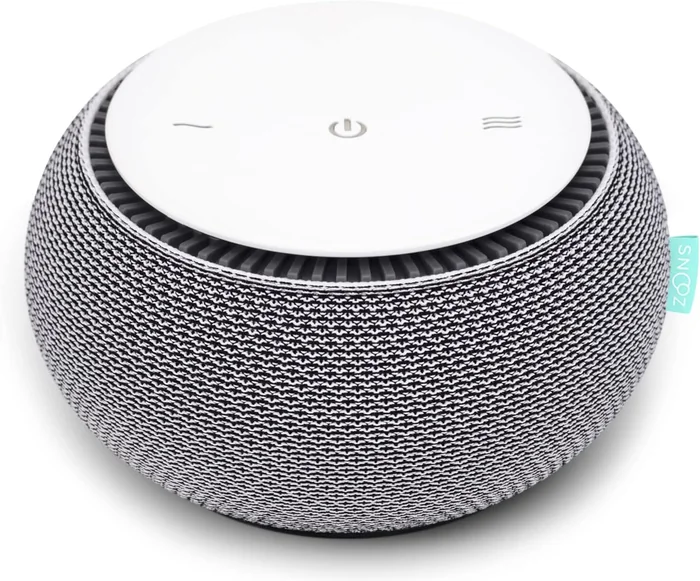
- 1Control surfaceThe white top that carries the buttons; the manual says not to grip it when turning the shell.
- 2Power buttonTurns the fan on and off; held for 5 seconds it starts pairing with the app.
- 3Volume buttonsOne on each side of the power button; each press steps the fan speed, and so the loudness, through 10 levels.
- 4Vent gapThe slotted ring under the top; the manual says air flows in from the top and out from the sides, which is why the unit must not be covered.
- 5Tone control shellThe knit-covered housing rotates: clockwise for a deeper tone, counterclockwise for a lighter one.
Spec plate
SNOOZ Original, Cloud · from the manual and spec page · Oct 15, 2026- Model
- SNOOZ Original (Amazon lists model no. BD3342), color Cloud
- Dimensions
- 5.6 x 5.6 x 3.2 in
- Weight
- 1.1 lb
- Power
- Plug-in adapter, 100-240 V, 6 ft cord; no battery
- Sound source
- Real fan; one sound, tone set by rotating the shell
- Controls
- 3 buttons on the unit; optional Bluetooth app
- App features
- Remote on/off and volume, on/off schedule with fade, nursery calibration, button brightness
- Warranty
- 1-year limited
- Regulatory status
- Not a medical device; consumer electronics (FCC ID QOQBGM113 for the radio module)
- Volume range
- 10 levels, 46-87 dBA measured at the device (SNOOZ)
Source: SNOOZ Original user manual, getsnooz.com spec list and Amazon listing B076F2JKYC, read Oct 15, 2026. The decibel range is SNOOZ’s figure measured at the device, not at the pillow; the level you hear depends on distance and the room. Volume range is the key row because the top of it is loud (see Before you buy).
01Operating principle
The SNOOZ makes its sound the way a desk fan does: air moved by a spinning fan, with the housing shaping what comes out.
A fan, not a speaker
Inside is a real fan. There are no recordings or digital tracks, so the sound does not loop [2][3].
Fan speed sets loudness
The 10 volume levels are 10 fan speeds; faster air is louder air. The unit remembers the last speed and returns to it when switched back on [1].
The shell shapes the tone
Rotating the fabric-covered shell around the fan shifts the character of the sound, deeper when turned clockwise and lighter when turned counterclockwise [1]. The manual does not explain the internal geometry, only the effect.
Masking by steady sound
A steady, broadband sound makes short, sudden noises from outside stand out less, because the ear hears the change against a louder background. That is the masking idea SNOOZ describes [3]; how much it matters for sleep is less settled (see the research below).
02Fit check
Good fit
- People who already like the sound of a fan at night but do not want air blowing on them
- A room near street noise, where the manual suggests placing the unit between the bed and the noise [1]
- Anyone who wants an on/off schedule from a phone, or a decibel check from the app’s calibration tool
Poor fit
- Anyone who wants rain, waves or music; this makes one fan sound with an adjustable tone
- Use without an outlet; it is corded and has no battery
- Anyone who wants total silence; even the lowest level is a constant sound
Check first
- Volume: the top of the range (87 dBA at the device) sits past NIDCD’s 85 dBA mark, the level at which extended or frequent exposure can damage hearing [4]
- Placement: the manual says do not cover it, keep it away from water, and use it indoors only [1]
- Nurseries: SNOOZ cites guidance to keep a sound machine at least 7 ft from a baby’s sleeping area at a comfortable level [2]
03What the research and the manual say
Studies of continuous background noise and sleep are mixed. A 2021 systematic review in Sleep Medicine Reviews screened 38 articles on continuous white or broadband noise; results ranged from better to worse sleep, and the reviewers rated the overall quality of evidence for improvement as very low [5]. A 2026 laboratory study of 25 healthy adults found that steady pink noise played during sleep shortened REM sleep, while foam earplugs did better at dulling intermittent traffic and aircraft sounds [6]. Neither study tested a SNOOZ, and a lab sound file is not the same as a fan, but both are reasons to regard a sound machine as a comfort choice, not a sleep tool with proven effects.
Some people keep steady background sound running in a very quiet room simply because they prefer it to silence; our background sound guide covers what the research does and does not show. The SNOOZ is a fan in a housing: it makes no health claim on our page, and it is not a medical device.
Plan to run it low. SNOOZ rates the range at 46-87 dBA at the device. NIDCD regards 70 dBA and under as unlikely to cause hearing damage however long it lasts, and puts the risk line for extended or frequent exposure at 85 dBA and up [4]. Sleep means hours of exposure, so use the lowest setting that works, keep the unit several feet from your head, and consider the app’s calibration tool to check the level where you sleep [1].
04Setup and care
These steps follow the SNOOZ user manual and listing; they describe placement and use, not a promised result.
Place it away from the bed
The manual says it works best away from the bed, near a wall, window or other hard surface, and not on a nightstand right beside you; if outside noise is the issue, put it between the bed and the noise [1]. The Amazon listing gives 3 to 6 ft from your head [3].
Set tone, then volume
Grip the fabric shell (not the white top) and rotate it for a deeper or lighter tone, then step the volume up from the lowest level only as far as you need [1].
Pair the app if you want a schedule
Install the SNOOZ app, tap +, and if the unit is not found, hold the power button for 5 seconds until the lights pulse [1]. The app adds remote control, a schedule timer and the decibel calibration.
Keep it uncovered, dry and on a sound cord
Do not cover it, use it near water, or run it with a damaged cord or adapter; unplug it when moving it or leaving it unused for a long time [1]. There are no user-serviceable parts inside.
05Price and where it is sold
On Oct 15, 2026 the SNOOZ Original in Cloud was $99.99 on Amazon, sold by SNOOZ (the brand’s store) and shipped from Amazon, with a free 30-day refund or replacement shown on the listing and the item in stock. A Charcoal color is a separate variation. SNOOZ’s own site describes a 100-night trial for direct purchases [2]; for an Amazon order, rely on the listing’s return line. See the Cloud listing on Amazon. As an Amazon Associate we earn from qualifying purchases.
06Who should look elsewhere
- Anyone who wants a choice of recorded sounds, or a battery unit for travel without an outlet
- Anyone hoping a sound machine will address a hearing or ear symptom; that is a question for a clinician or audiologist, and this device makes no such claim
- Light sleepers bothered mainly by loud intermittent noise; the 2026 study above found earplugs did more than steady background sound [6]
Sources
- SNOOZ, Inc. SNOOZ Original user manual: controls, tone shell, placement, app pairing, nursery calibration, warnings, FCC statement and 1-year limited warranty. Read Oct 15, 2026 (PDF copy of the manufacturer’s booklet).
- SNOOZ. SNOOZ White Noise Machine product page and spec list (dimensions, weight, 46-87 dBA range, adapter, cord, app features, warranty, trial, nursery placement note). Accessed Oct 15, 2026. link
- Amazon. SNOOZ Original Smart White Noise Sound Machine, listing B076F2JKYC: feature bullets and technical details. Accessed Oct 15, 2026 (linked in the price section above).
- National Institute on Deafness and Other Communication Disorders (NIDCD). Noise and hearing: decibel levels and exposure time. Accessed Oct 15, 2026. link
- Systematic review of continuous noise used as a sleep aid (38 articles). Sleep Medicine Reviews, 2021;55:101385. PMID 33007706. PubMed
- Laboratory study of pink noise and earplugs with intermittent environmental noise (25 adults, seven nights). Sleep, 2026;49(5):zsag001. PMID 41627391. PubMed
This entry is educational and is not medical advice. It describes what a device does and what its labeling says; it does not say the device will change any health condition. If you notice a change in your hearing or a persistent sound in your ears, see a clinician or audiologist.