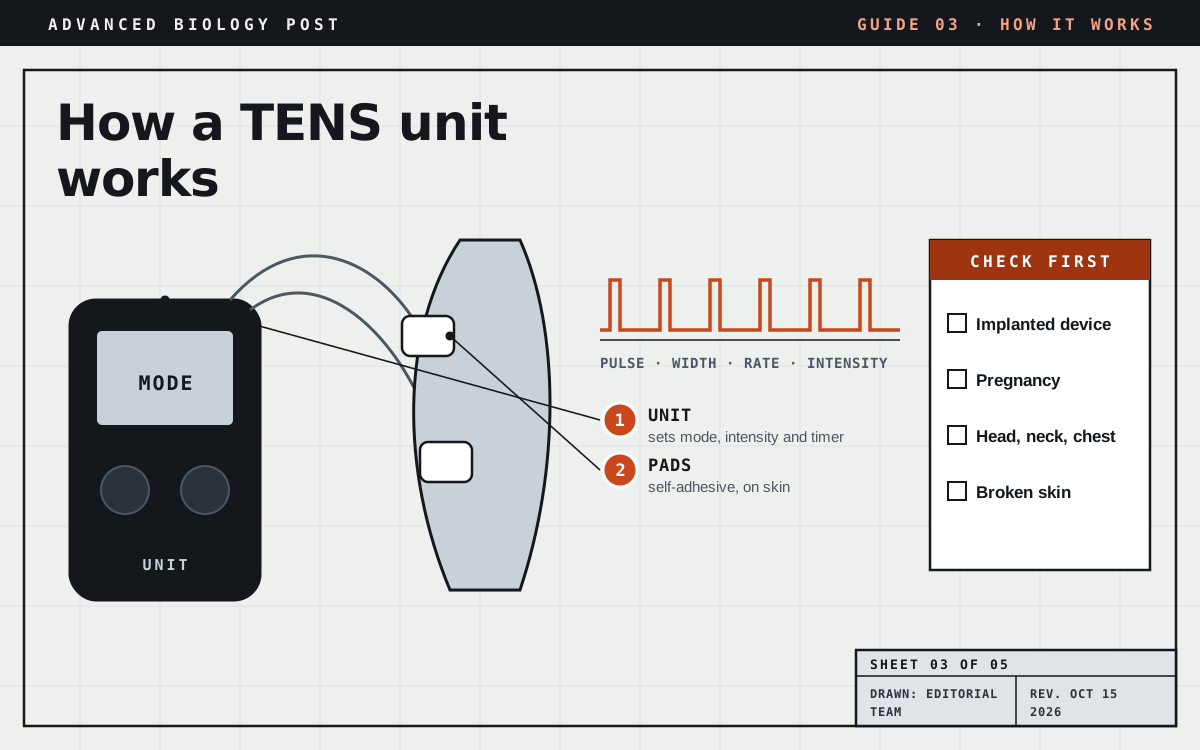
TENS stands for transcutaneous electrical nerve stimulation: a battery unit pushes a weak current through the skin, out of one self-adhesive pad and back through another, in short pulses you feel as tapping or buzzing. What it physically does is simple to describe; how much it helps any one person is not well established, and some people should not use one at all.
The parts: unit, cord and pads
Every home TENS kit has the same three parts. The unit holds the batteries, a small circuit that shapes the pulses, and the buttons for mode, intensity and power; most also run a session timer. The cord carries the current to the pads. The pads (electrodes) are pieces of conductive gel on a backing that stick to the skin.
The pads always work in pairs. Current leaves the unit through one pad, passes through the skin and the tissue between the pads, and returns through the other. With one pad, there is no circuit, which is why Omron’s manual says therapy “won’t work with just one pad” and asks for the pads to sit at least 1 inch (3 cm) apart, never touching or overlapping [3]. A unit with one output (one channel) drives one pair; two-channel units drive two pairs.
A TENS unit only works on the skin under and between its two pads. Where the pads go is the most important setting, and the manual’s placement limits are the most important rules.
Pulse, width, rate and intensity
Four numbers describe what the unit sends:
- Pulse: one brief burst of current. Home units send trains of them, separated by gaps.
- Width (duration): how long each pulse lasts, measured in microseconds. Omron lists 150 µs for the PM500 [3].
- Rate (frequency): how many pulses per second. A low rate feels like separate taps; a high rate blurs into a buzz. The PM500 spans about 1 to 238 Hz across its modes [3].
- Intensity: how strong each pulse is, set in steps. The PM500 has 15 levels and tops out at 70 V into a 500-ohm test load [3].
Consumer units usually hide these numbers behind named modes. A mode is a preset pattern of rates and widths: Omron’s manual, for example, describes its Foot mode as “low rate tapping, pulsing sensations” and its Rub mode as high-rate pulsing meant to feel like rubbing hands [3]. You pick the mode, then raise intensity from the lowest step until the sensation is clear but comfortable.
A session, step by step
This is the order Omron’s PM500 manual gives; other brands differ in detail, so follow your own unit’s manual [3].
Check the parts before each use
Cord not broken, gel not damaged, connections secure, no battery leakage.
Place the pads unit off
On clean, dry, unbroken skin, on either side of the area, at least 1 inch apart. No lotion or cream under the pads.
Switch on and choose a mode
Only after the pads are on the skin. One mode at a time.
Raise intensity slowly
Start at the lowest level and step up. If the sensation becomes uncomfortable, step down.
Let the timer run 15 minutes
The PM500 stops after 15 minutes; Omron’s limit is 30 minutes per session, up to three times a day.
Stop and look at the skin
If the skin is red or irritated, the manual says not to stimulate that area again.
What an over-the-counter clearance covers
In the United States, TENS devices are classified under 21 CFR 882.5890 as Class II devices [1]. A home unit reaches the market through a 510(k): the maker shows FDA that the device is substantially equivalent to one already legally sold, and FDA “clears” it with a K-number [6]. Over-the-counter TENS units have their own product code, NUH [4].
Each clearance has a specific indication. For the Omron PM500 (510(k) K182120, where the device is named Model PM3032B; FDA’s device identifier database ties the PM500 to that number), it is, in neutral terms, over-the-counter use by adults on sore or aching muscles of the lower back, arms, legs, shoulder or foot after strain from exercise or normal household work activities [2]. A clearance is about equivalence and labeling; it is not a statement that a device will work for a particular person, and it does not cover uses outside that indication. Our guide to FDA wording walks through how to look a K-number up.
TENS is not the same as EMS
The two get sold side by side and can look identical. FDA classifies them under different regulations. A TENS device applies current through skin electrodes and is regulated under 882.5890 [1]. A powered muscle stimulator, often sold as EMS, is defined as a device that “repeatedly contracts muscles by passing electrical currents through electrodes” (21 CFR 890.5850) [7]. So the practical difference is in the definition: EMS is about making muscles contract, while the TENS manuals we read describe the session as a tapping or pulsing sensation on the skin [3]. If a box mentions both, the 510(k) record shows which uses were cleared.
Check first: who should not use one
These come from the contraindication in the FDA 510(k) summary and the warnings in Omron’s PM500 manual [2][3]. Other units carry similar lists; read the one that comes with yours.
- Implanted device. Do not use with a cardiac pacemaker, implanted defibrillator or other implanted metallic or electronic device; both sources warn of electric shock, burns, electrical interference or death.
- Pregnancy. The manual lists pregnant women among the people the unit should not be used on.
- Head, neck, chest. No pads on the head, mouth or face; none on the neck or throat; none near the heart, across the chest, or on both sides of the chest at once.
- Broken skin. No pads on open wounds or rashes, on swollen, red or inflamed skin, or on skin that lacks normal feeling.
- Also on the list. Not for children; not in the bath or shower, while sleeping or while driving; not on both calves, or the bottoms of both feet, at the same time. People with a known heart or seizure condition, or a recent operation, are told to follow their physician’s advice first.
If you have reduced feeling in the area, an implanted device, a heart condition, or are pregnant, ask a clinician before trying TENS. Stop if the skin under the pads turns red, burns or itches, or if anything feels wrong. This guide explains a device; it is not a recommendation to use one.
What the research says
The best summary is a 2019 Cochrane overview of earlier Cochrane reviews of TENS in adults with long-lasting pain. It drew its data from eight reviews covering 51 randomized trials and 2,895 participants, all adults with pain lasting more than three months. The review authors rated the evidence in every review as very low quality, mainly because most trials were small (fewer than 50 people per group) and had design limitations, and concluded that they could not say with any confidence whether TENS helps or harms; they also found too little usable data to report meaningfully on side effects [5]. Omron’s own manual is similarly careful: it says the long-term effects of electrical stimulation are unknown and that effectiveness depends heavily on patient selection by a qualified practitioner [3].
For an ordinary evening at home, that means three things: follow the placement rules exactly, keep sessions inside the manual’s limits, and regard any benefit as personal and uncertain rather than promised.
Sources
- Electronic Code of Federal Regulations. 21 CFR 882.5890, transcutaneous electrical nerve stimulators: identification and Class II classification. link
- U.S. Food and Drug Administration. 510(k) K182120, Omron Healthcare Maxpower Relief Model PM3032B: indications for use, contraindication and device comparison. Jan 10, 2019. link
- Omron Healthcare. Max Power Relief PM500 instruction manual (warnings, pad placement, modes, specifications). Accessed Oct 15, 2026. link
- U.S. Food and Drug Administration. Product classification database, product code NUH (over-the-counter transcutaneous nerve stimulator). Accessed Oct 15, 2026. link
- Cochrane Database of Systematic Reviews. Overview of Cochrane reviews of TENS in adults with long-lasting pain (CD011890.pub3), 2019. PMID 30941745. link
- U.S. Food and Drug Administration. Premarket Notification 510(k). Accessed Oct 15, 2026. link
- Electronic Code of Federal Regulations. 21 CFR 890.5850, powered muscle stimulator. link
This guide is educational and is not medical advice. Ask a qualified clinician before starting a new device or routine, especially if you have an existing condition, reduced feeling in your feet, an implanted device, or take medication.