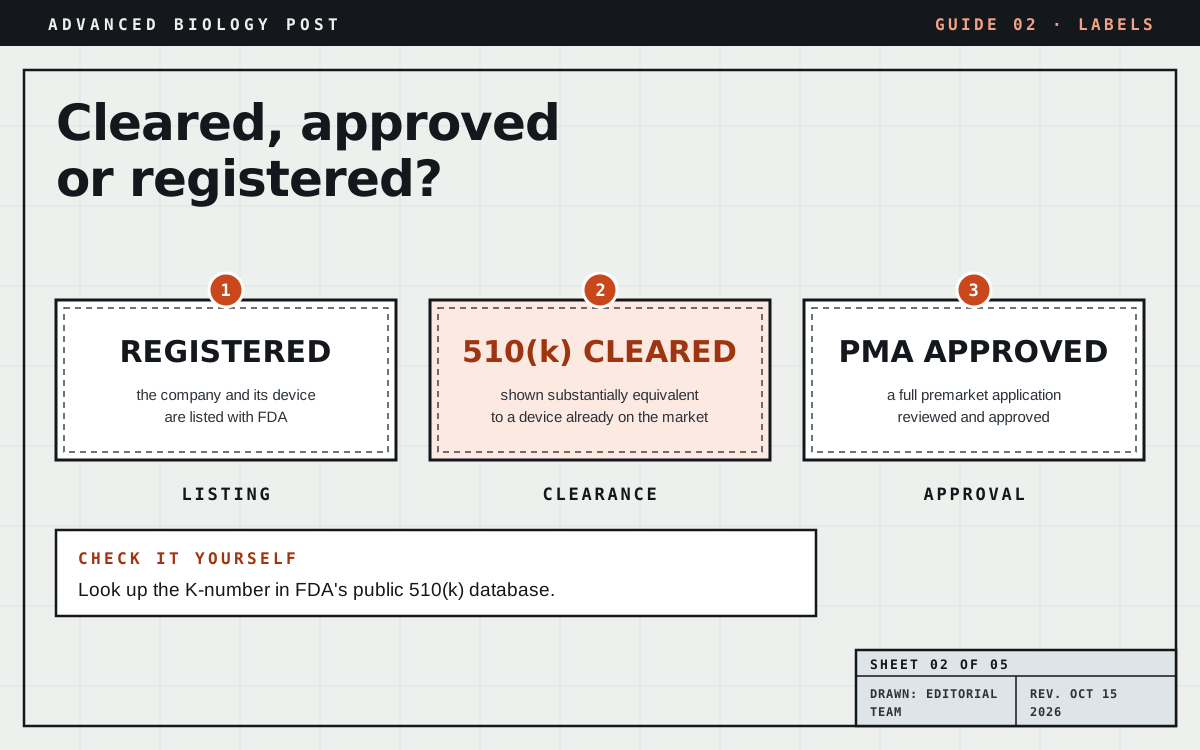
For a medical device, “registered” means the company and its products are on file with FDA, “cleared” means FDA agreed the device is substantially equivalent to one already legally sold, and “approved” means FDA reviewed a full premarket approval application, the route for the highest-risk devices. Most home comfort gadgets are registered, cleared or exempt; almost none are approved, so a box that says FDA approved
on a heating pad or a TENS unit is using the wrong word.
Start with the class
FDA sorts devices into three classes by risk, and the class decides what has to happen before a device is sold [4]:
- Class I (lowest risk): general controls. Most are exempt from premarket notification. An electric massager is Class I and exempt [7].
- Class II (moderate risk): general and special controls. A 510(k) is required unless the device type is exempt [4]; a powered heating pad is Class II and exempt [8], while a TENS unit is Class II and needs one, which is why home TENS units carry K-numbers.
- Class III (highest risk): usually needs premarket approval (PMA) [2].
The class comes from the device’s classification regulation in Title 21 of the Code of Federal Regulations, and FDA says classification depends on the device’s intended use and indications for use [4]. Each type also has a three-letter product code you can search in FDA’s classification database.
Registered and listed
Owners or operators of establishments that make or distribute devices for the U.S. register with FDA every year, and generally also list the devices they make there [3]. That is a filing, not a review. The regulation is blunt: registration “does not in any way denote approval of the establishment or its products”, and implying official approval because of registration is misbranding (21 CFR 807.39) [9].
A real example: Therabody’s manual for the Theragun Mini prints “FDA-Registered”, and FDA’s listing database shows “Theragun Mini (All Generations)” under the code for electric therapeutic massagers [13], a Class I, exempt type [7]. Accurate, and it tells you the paperwork is in order; it tells you nothing about how well the device works.
“Registered” describes a company’s filing. “Cleared” describes one device’s 510(k). “Approved” describes a PMA. They are not three levels of the same thing.
510(k) cleared
A 510(k) is a premarket submission in which the maker shows that its device is as safe and effective as, that is, substantially equivalent to, a device already legally on the U.S. market, called the predicate. If FDA agrees, it issues an order, in the form of a letter, that “clears” the device for commercial distribution [1]. The submission is known by its 510(k) number, a K followed by six digits, such as K182120 [6]. Substantial equivalence means the same intended use and either the same technology, or different technology that raises no new questions of safety and effectiveness; the two devices do not have to be identical [1].
The regulations are careful about the wording here too. A finding of substantial equivalence “does not in any way denote official approval of the device”, and any representation that creates that impression is misbranding (21 CFR 807.97) [10]. That is why accurate labeling says “FDA cleared” and quotes the K-number.
PMA approved
Premarket approval is FDA’s most stringent route for devices. It applies to Class III devices, those that support or sustain human life or present a potential, unreasonable risk of illness or injury, and approval rests on FDA’s determination that the application contains sufficient valid scientific evidence that the device is safe and effective for its intended use [2]. FDA’s own consumer article gives mechanical heart valves and implantable infusion pumps as examples [5]. Pillows, heating pads, massagers and over-the-counter TENS units are nowhere near this category.
Exempt
Many low-risk device types need no premarket submission at all. Their classification regulation says so, subject to limits spelled out in a “.9” section of each classification part (for physical medicine devices, 21 CFR 890.9) [4]. The Sunbeam XL heating pad is an example: FDA’s device identifier database lists it under product code IRT, the powered heating pad regulation, which is Class II and exempt from premarket notification [8]. There is no K-number to find, and that is normal, not a red flag.
How to look up a K-number
The cover says it: look up the K-number in FDA’s public 510(k) database. Here is the worked example we used for the Omron TENS unit.
Find the exact model on the box or manual
The manual Omron publishes for the unit sold on the Amazon listing says Max Power Relief PM500. Model numbers matter: Omron says the PM500 replaced the PM3032.
Find the K-number
Check the manual or box first. If it is not printed, FDA’s device identifier database (GUDID) often lists it: the PM500 entry names premarket submission K182120 [11].
Open the 510(k) record
Search the number in FDA’s Premarket Notification database [6]. K182120 shows Omron Healthcare as applicant, a decision date of Jan 10, 2019, the device name “Maxpower Relief” and product codes NUH and NYN; the clearance letter and summary name the model as PM3032B.
Read the summary PDF
It holds the indications for use, contraindications and the predicate. Here, the primary predicate is the original PM3032 (K141978); the summary says the device is identical to it except for the CPU and related components, and that the submission’s purpose was to add a further indication [12].
Compare it with the box
The indication in the record is what was cleared. Claims on a box or a listing that go beyond it were not part of the clearance.
Why FDA approved
on a cleared gadget is wrong
FDA’s consumer article on the phrase explains that the agency approves new drugs and biological products and, for devices, approves the highest-risk Class III devices through PMA; moderate-risk devices reach the market through 510(k) clearance, and most low-risk devices are exempt [5]. It also says registration of an establishment or listing of a device does not denote approval [5]. So a cleared TENS unit, an exempt heating pad or a registered massager described as FDA approved
is described inaccurately, and the regulations call that kind of implied approval misbranding [9][10].
- Does the box or manual name a K-number, or say exempt? A K-number can be checked in two minutes.
- Does the model letter on the box match the model in the FDA record?
- Is the claim on the box inside the cleared indication, or beyond it?
- Does it say
FDA approved
for a device that is not Class III? Read the rest of the copy with the same caution.
A clearance, a listing or an exemption is a statement about regulatory paperwork, not a promise that a device will help you. If you have an implanted device, are pregnant, have reduced feeling in your feet or an existing condition, ask a clinician before using an electrical, heated or massage device, whatever its box says.
Sources
- U.S. Food and Drug Administration. Premarket Notification 510(k). Accessed Oct 15, 2026. link
- U.S. Food and Drug Administration. Premarket Approval (PMA). Accessed Oct 15, 2026. link
- U.S. Food and Drug Administration. Device Registration and Listing. Accessed Oct 15, 2026. link
- U.S. Food and Drug Administration. Classify Your Medical Device. Accessed Oct 15, 2026. link
- U.S. Food and Drug Administration. Consumer update on what the agency does and does not approve (
Is It Really ‘FDA Approved’?
). Accessed Oct 15, 2026. link - U.S. Food and Drug Administration. 510(k) Premarket Notification database, record K182120. link
- Electronic Code of Federal Regulations. 21 CFR 890.5660, therapeutic massager (Class I, exempt). link
- Electronic Code of Federal Regulations. 21 CFR 890.5740, powered heating pad (Class II, exempt). link
- Electronic Code of Federal Regulations. 21 CFR 807.39, misbranding by reference to establishment registration. link
- Electronic Code of Federal Regulations. 21 CFR 807.97, misbranding by reference to premarket notification. link
- U.S. Food and Drug Administration. Global Unique Device Identification Database entry for Omron PM500 (via openFDA). Accessed Oct 15, 2026. link
- U.S. Food and Drug Administration. 510(k) summary for K182120 (PDF). Jan 2019. link
- U.S. Food and Drug Administration. Establishment registration and device listing database, Therabody, Inc., product code ISA (via openFDA). Accessed Oct 15, 2026. link
This guide is educational and is not medical advice. Ask a qualified clinician before starting a new device or routine, especially if you have an existing condition, reduced feeling in your feet, an implanted device, or take medication.