Exploded view
Part SP-01 · callouts from the label and the listing · Oct 15, 2026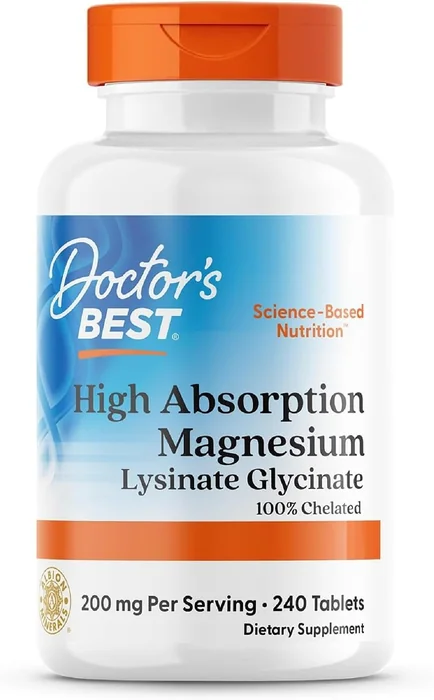
- 1Screw capAn orange cap on a wide-mouth bottle that holds all 240 tablets.
- 2Lysinate Glycinate, 100% ChelatedThe form: magnesium bound to the amino acids lysine and glycine rather than supplied as a plain salt such as an oxide.
- 3200 mg Per Serving · 240 TabletsA serving is two tablets of 100 mg magnesium each, so the bottle holds 120 servings.
- 4Albion Minerals sealMarks the chelate as Albion’s TRAACS ingredient; Doctor’s Best notes these are trademarks of Balchem Corporation.
Spec plate
DRB-00087, 240 tablets · from the label and listing · Oct 15, 2026- Model
- High Absorption Magnesium, 240 tablets (model DRB-00087, UPC 753950000872)
- Form
- Tablet; 100 mg magnesium per tablet
- Amount per serving
- 200 mg magnesium (48% DV) in 2 tablets
- Source of magnesium
- 2,000 mg magnesium lysinate glycinate chelate (Albion) per serving
- Servings per bottle
- 120
- Other ingredients
- Microcrystalline cellulose, croscarmellose sodium, magnesium stearate (vegetable source), stearic acid, hydroxypropyl cellulose, silicon dioxide, hypromellose
- Label free-from icons
- Vegan, gluten free, soy free, non-GMO (brand statements)
- Suggested adult use
- 2 tablets twice daily, or as a physician recommends (400 mg a day)
- Storage
- Cool, dry place
- Bottle size
- 3.13 x 3.13 x 5.19 in (listing)
- Quality marks
- No third-party testing seal on the label we read
- Regulatory status
- Dietary supplement; not reviewed by the FDA before sale
Source: the Supplement Facts panel in the Amazon gallery for B000BD0RT0 and the product data on doctorsbest.com, read Oct 15, 2026; the two match. The key row is the serving, because the label’s own daily direction is two servings, which is where the intake limit below comes in.
01How it’s taken, and what’s in a serving
Nothing here runs on a motor: a serving is two tablets, and the useful questions are how much magnesium they carry, in what form, and how that adds up across a day.
Two tablets, 200 mg
Each serving lists 2,000 mg of magnesium lysinate glycinate chelate, which supplies 200 mg of magnesium itself; the remaining weight is the amino acids the magnesium is bound to [1][2]. The 48% Daily Value on the label is 200 mg set against the 420 mg reference figure used on labels.
A chelated form
“Chelated” means each magnesium atom is held by amino acids. The brand calls the product 100% chelated and markets it as better absorbed than other forms; that comparison is the brand’s, and we did not verify it. NIH’s consumer fact sheet names aspartate, citrate, lactate and chloride as forms that are more easily absorbed and does not rank glycinate either way [3].
Tablet-making ingredients
The other ingredients are common tablet excipients: cellulose and hypromellose as binders and coating, croscarmellose sodium to help the tablet break apart, and magnesium stearate, stearic acid and silicon dioxide as flow aids. The label lists them; it does not state their roles, so those are the usual ones, not the brand’s description.
Adding up the day
Magnesium in food does not count toward the federal upper limit; magnesium from supplements and medicines does. For adults that limit is 350 mg a day [3]. One serving (200 mg) sits under it; the label’s full direction of two tablets twice daily (400 mg) sits above it.
02Fit check
Good fit
- Adults who want magnesium on its own, unflavored, in a measured 100 mg-per-tablet unit
- Buyers who want a label stating vegan, gluten-free and soy-free (brand statements)
- Someone taking one serving a day: the bottle then lasts 120 days
Poor fit
- Anyone who would follow the label’s four-tablet direction without a clinician’s say-so, since that exceeds the adult upper limit
- Children: the upper limit is 65 mg at ages 1–3 and 110 mg at ages 4–8 [3], below even one tablet for the youngest
- Buyers who want a returnable listing: it is non-returnable
Check first
- Bisphosphonates (bone medicines) and some antibiotics absorb poorly if taken too close to a magnesium supplement; ask a pharmacist about spacing [3]
- Diuretics can raise or lower magnesium loss, and some prescription acid-reflux medicines used long term can lower blood magnesium [3]
- Reduced kidney function, pregnancy or breastfeeding: talk to a clinician before adding any mineral supplement
03What the label and the NIH fact sheet say
NIH’s Office of Dietary Supplements puts the recommended daily amount at 400–420 mg for adult men and 310–320 mg for adult women, counting food, drinks and supplements together [3]. It notes that many people in the United States eat less than that, but that total intake is generally above the recommended amounts once supplements are counted. Legumes, nuts, seeds, whole grains, green leafy vegetables and fortified cereals are the main food sources it lists.
On the downside, the same fact sheet says high intakes from supplements and medicines can cause diarrhea, nausea and abdominal cramping, and that extremely high intakes can disturb the heartbeat [3]. That is the reason the upper limit applies only to supplemental magnesium, and the reason we flag the label’s own daily direction.
The bottle and the listing also make function claims about muscles and rest. Like every such claim on a supplement, those have not been evaluated by the FDA, and we do not repeat them. The label carries the standard notice: These statements have not been evaluated by the Food and Drug Administration. This product is not intended to diagnose, treat, cure, or prevent any disease.
Under federal law the FDA does not approve dietary supplements before they are marketed and does not test them before they are sold [4].
The label’s suggested adult use is 2 tablets twice daily, which is 400 mg of magnesium; NIH’s upper limit for magnesium from supplements is 350 mg a day for adults unless a health care provider recommends more [3]. One serving stays under it. The Amazon listing is also non-returnable, except for items that arrive damaged or defective.
04Taking and storing it
These steps follow the label and the NIH fact sheet; they describe use and storage, not a promised result.
Check your medicines first
If you take a bisphosphonate, an antibiotic, a diuretic or a long-term acid-reflux prescription, ask your pharmacist how to time magnesium around it [3].
Count every source
Add any magnesium in a multivitamin, an antacid or a laxative to the tablets before comparing your total with the 350 mg limit for supplements and medicines.
Take the serving
One serving is two tablets. The label does not tie them to meals; if loose stools follow, that is one of the effects NIH lists for higher supplemental doses [3].
Store it dry
Keep the bottle closed in a cool, dry place, as the label directs [2].
05Price and where it is sold
On Oct 15, 2026 the 240-tablet bottle was $23.99 on Amazon, sold by Doctor’s Best and shipped from Amazon, in stock, with the return line “Non-returnable due to Food safety reasons” (a refund or replacement only if the item arrives damaged or defective). A subscribe-and-save price was also offered. That works out to about 20 cents per two-tablet serving. See the 240-tablet listing on Amazon. As an Amazon Associate we earn from qualifying purchases.
06Who should look elsewhere
- Children, unless a pediatric clinician has set a dose: their upper limits are far below an adult serving [3]
- Anyone with reduced kidney function, or on interacting medicines, until a clinician or pharmacist has reviewed it
- Anyone who wants smaller steps than 100 mg: Doctor’s Best also lists a 52.5 mg capsule version of this chelate [2]
Sources
- Amazon. Doctor’s Best High Absorption Magnesium, 240 tablets, listing B000BD0RT0: Supplement Facts image, product details, seller and return line. Accessed Oct 15, 2026 (linked in the price section above).
- Doctor’s Best. High Absorption Magnesium, 100 mg, 240 Tablets: Supplement Facts, other ingredients, suggested adult use, storage. Accessed Oct 15, 2026. link
- NIH Office of Dietary Supplements. Magnesium: Fact Sheet for Consumers (recommended amounts, upper limits, side effects, medicine interactions). Updated Mar 22, 2021; accessed Oct 15, 2026. link
- U.S. Food and Drug Administration. Questions and Answers on Dietary Supplements (premarket review, testing, the required disclaimer). Accessed Oct 15, 2026. link
This entry is educational and is not medical advice. It describes what is in a product and what its label says; it does not say the product will change any health condition. Talk to a clinician or pharmacist before taking a supplement if you take medication, are pregnant or breastfeeding, or manage a health condition.