Exploded view
Part MW-02 · callouts from the listing and its photos · Oct 15, 2026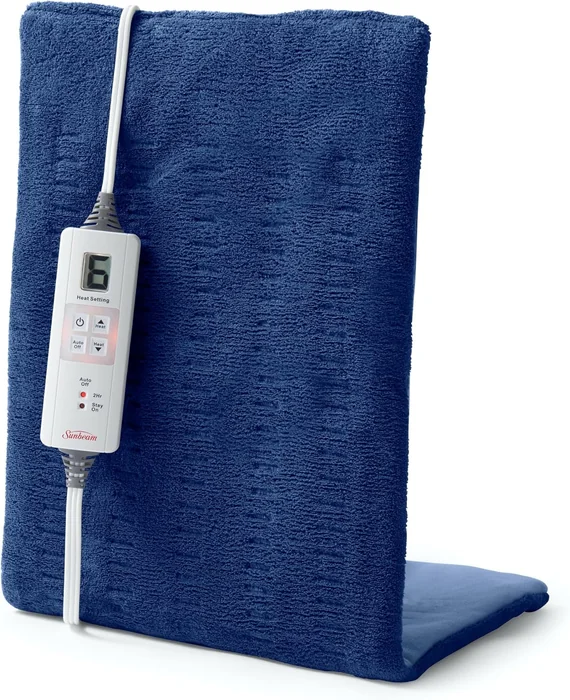
- 1PadA 12 x 24 in plush fabric pad with the heating element inside; it unplugs from the controller cord so the whole pad can go in the washer.
- 2Backlit digital screenShows the heat setting from 1 to 6 and stays readable in a dark room.
- 3Power, Heat and Auto Off buttonsPower switches the pad on; the Heat arrows raise or lower the setting one step; Auto Off chooses between the 2-hour timer and continuous heat.
- 4Auto Off lightsTwo indicators, “2Hr” and “Stay On”, that show which timer mode is selected.
Spec plate
Model 2153188 · from the listing and FDA databases · Oct 15, 2026- Model
- Sunbeam 2153188, XL (king size), Navy; UPC 053891160100
- Pad size
- 12 x 24 in
- Weight
- 1.37 lb boxed (pad alone not stated)
- Power
- 120 V AC, 60 Hz, 180 W
- Heat settings
- 6, on a backlit digital controller
- Cord
- 9 ft
- Materials
- Plush fabric (fiber content not stated)
- Care
- Whole pad machine-washable and dryer-safe once the controller is disconnected
- Warranty
- Not stated on the listing
- Regulatory status
- Powered heating pad, Class II, exempt from 510(k) (21 CFR 890.5740, product code IRT)
- Auto-off
- Optional: 2-hour shut-off, or “Stay On” with no timer
Sources: Amazon listing B0B32R3BB3 (technical details, description, gallery), FDA’s device identifier database [1], FDA’s classification database [2] and eCFR [3], read Oct 15, 2026. Auto-off is the key row because the controller can be set to run without a timer. We could not find Sunbeam’s instruction leaflet for model 2153188 online that day (sunbeam.com blocked our requests), so the care and timer rows come from the listing, not the leaflet.
01Operating principle
An electric heating pad is a resistance heater sewn into fabric: current through a fine wire makes heat, and the controller decides how much current flows and for how long.
Wire becomes warm
Mains power at 120 V runs through a heating element spread across the pad; at full power the listing rates it at 180 W. Sunbeam calls its fast warm-up “XpressHeat” and says heat can be felt in about 30 seconds.
The controller sets the level
Six settings change how much power the element gets. The screen shows the number, and Sunbeam describes a “Heat Meter” that glows progressively while the pad warms.
The timer decides when it stops
In “2Hr” mode the pad switches itself off after two hours; in “Stay On” mode it keeps heating until you switch it off or unplug it.
Optional damp heat
Sunbeam says the fabric can be sprayed with water for a moist-heat option. The listing gives no further detail on how damp the fabric should be.
02Fit check
Good fit
- Adults who want warmth over a wide flat area, such as across the back or the thighs, while sitting up and awake
- Anyone who wants a pad that can go through the washer and dryer
- People who need the controller to be readable in low light
Poor fit
- Use in bed or anywhere you might fall asleep; University of Utah Health names falling asleep on a pad as a common route to burns
- Folding the pad up tightly for storage: University of Utah Health notes the element stiffens with use and flags folding and wrapping as an electrical safety risk
- Anyone who wants a cordless or battery pad
Check first
- The listing’s safety note says not to leave the pad unattended and to use it only on the body parts it is intended for
- University of Utah Health singles out older adults and people with reduced feeling in the skin or paralysis as higher-risk users; ask a clinician before using one if that applies to you
- Never on infants or on someone who is paralyzed, per the same University of Utah Health article
- Read the instruction leaflet in the box before first use; it carries Sunbeam’s full warnings
03How it holds up as a device
This is a plain household appliance with a medical-device classification. FDA’s device identifier database lists UPC 053891160100, the code on this listing, as a Sunbeam “Heating Pad” under product code IRT [1]. IRT is FDA’s code for a powered heating pad, 21 CFR 890.5740: Class II, but exempt from premarket notification, so there is no 510(k) number to look up [2][3]. That is a statement about paperwork, not about how warm, even or durable a particular pad is.
What the listing does document: six settings, an optional 2-hour shut-off, a 9-foot cord and a pad that unplugs from its controller for washing. Its title and bullets also use condition words and outcome language that we do not repeat; heat does what heat does, and the useful questions for a buyer are size, settings, timer and washing. The main safety question is burns. University of Utah Health notes that a pad reaches about 120°F at most, yet a few hours of contact in one place can cause a second-degree burn, and that the risk is highest for people who cannot feel the heat or move away from it [4].
The controller can be set to “Stay On”, which means no automatic shut-off. If you might doze off, leave it in “2Hr” mode, and keep sessions short, as University of Utah Health advises for any heating pad.
04Setup and care
These steps follow the listing’s directions and Sunbeam’s description, plus the general burn precautions above; the leaflet in the box is the full authority.
Connect and plug in
Join the controller cord to the pad connector firmly, then plug into a 120 V outlet.
Choose the timer
Press Power, then use Auto Off to light “2Hr” (shuts off after two hours) unless you have a reason to need “Stay On”.
Start low
Pick a low number with the Heat arrows and raise it only as needed. Lift the pad and look at the skin now and then.
Switch off and unplug
Turn it off at the controller and unplug it when you are done, rather than relying on the timer.
Wash
Disconnect the controller from the pad, then machine-wash and tumble-dry the pad, per the listing.
05Price and where it is sold
On Oct 15, 2026 the Amazon listing for the XL navy pad (model 2153188) showed $49.22, shipped and sold by Amazon.com, in stock, with a free 30-day refund or replacement. See the listing on Amazon (as an Amazon Associate we earn from qualifying purchases).
06Who should look elsewhere
- Anyone who wants warmth while falling asleep: a pad is not designed for that.
- Anyone with reduced feeling in the skin who has not talked to a clinician about heat.
- Anyone who wants pressure or movement rather than warmth: a percussion massager is a different tool.
Sources
- U.S. Food and Drug Administration. Global Unique Device Identification Database entry for Sunbeam Heating Pad, device identifier 00053891160100 (via openFDA). Accessed Oct 15, 2026. link
- U.S. Food and Drug Administration. Product classification database, product code IRT (powered heating pad). Accessed Oct 15, 2026. link
- Electronic Code of Federal Regulations. 21 CFR 890.5740, powered heating pad: Class II, exempt from premarket notification. link
- University of Utah Health. Heating pads can cause second-degree burns (The Scope), Nov 23, 2018. link
This entry is educational and is not medical advice. It describes what a device does and what its labeling says; it does not say the device will change any health condition. Ask a qualified clinician before using a device like this if you are pregnant, have an implanted device, have reduced feeling in the area, or have an existing condition.